
When selecting a control valve, many engineers think of the single-seat type first — simple design, long history, well-documented catalog data. But when service conditions demand better wear resistance, tighter shutoff and wider rangeability, the eccentric rotary control valve (camflex-type) is often the better answer. How do you choose between the two? This article compares both across five dimensions: motion, wear life, sealing, rangeability and service fit.
1. Motion: linear stroke vs eccentric rotation
In a single-seat control valve the plug travels axially along the seat centerline. Throughout the stroke the plug's sealing face slides against the seat — every throttling cycle is one grinding cycle. The higher the actuation frequency, the faster the wear.
In an eccentric rotary control valve the plug is an eccentrically mounted spherical cam. On opening, the plug swings clear above the seat into the flow passage and the sealing surfaces barely touch through the stroke; only at the final instant of closing does the plug press onto the seat via the flex arm's elastic deformation. This "clear first, then compress" action eliminates rubbing during opening and closing at the structural level.
Sizing tip: for loops with frequent actuation, the eccentric rotary design has an inherent advantage in wear control.
2. Wear and life: which lasts longer
Seat wear in a single-seat valve is linear — every stroke consumes sealing-face material. In high-temperature or erosive services the sealing faces develop grooves quickly, leakage rises progressively, and the typical symptoms are poor shutoff and instability at small openings.
In an eccentric rotary valve the sealing surfaces do not contact during the stroke; wear is concentrated on the brief pressing contact at closing, so per-stroke wear is far lower than in a single-seat valve. The plug and seat can additionally be hard-faced with Stellite alloy for further life extension. Even after prolonged service, the flex arm's elastic deformation continues to compensate for any wear, unlike the sharp leakage escalation seen in worn single-seat valves.
Sizing tip: the life advantage of eccentric rotary valves is most pronounced in high-temperature services, media carrying solid particles, or coking duties.
3. Sealing performance and leakage class
Single-seat control valves use flat seating; metal-seated leakage is typically 0.01%–0.1% of rated capacity (ANSI/FCI 70-2 Class III–IV), and soft-seated versions can reach Class VI. However, soft trim (PTFE/RTFE) is temperature-limited, usually to about 200 °C.
The eccentric rotary valve uses spherical seating with more uniform sealing stress distribution. Metal-seated leakage is on the order of 1×10⁻⁴ of rated capacity, and soft-seated versions reach Class VI per GB/T 4213-2008. A further advantage of spherical seating is insensitivity to small particles in the medium — particles are unlikely to lodge on a spherical surface, whereas flat seating leaks once a particle wedges between the faces.
Sizing tip: for loops combining throttling and shutoff, or where leakage class Class V or above is required, the spherical seating of an eccentric rotary valve is more reliable.
4. Rangeability and control accuracy
Single-seat control valves typically offer 30:1 to 50:1 rangeability with equal-percentage or linear inherent characteristic. At low openings (<10%) the plug approaches the seat plane, flow area changes sharply and control stability degrades.
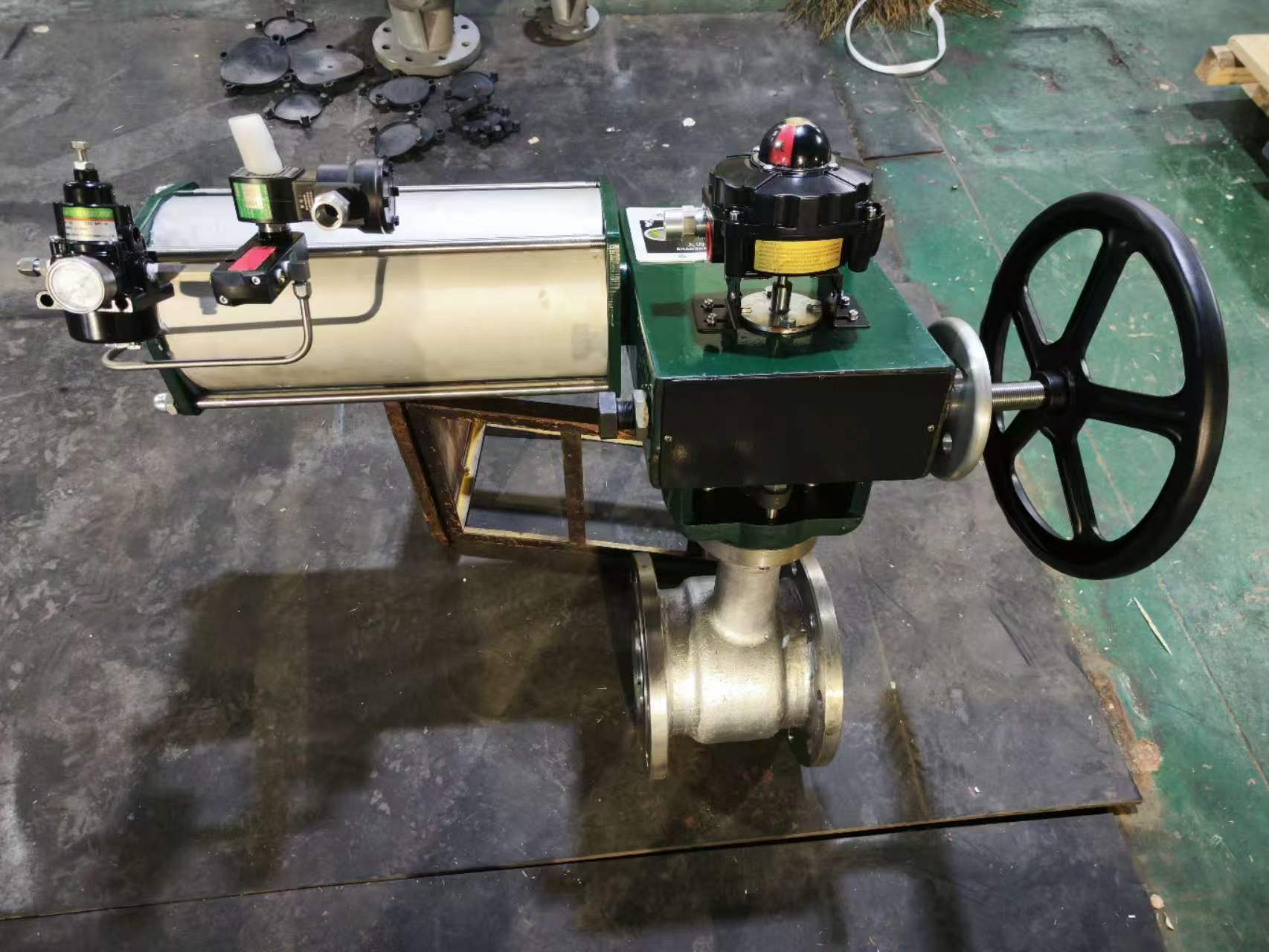
Taking the ZSPF/ZSNF series under the Dacheng brand in Shanghai as an example, the eccentric rotary control valve achieves 100:1 inherent rangeability with an approximately linear characteristic; when equal-percentage is needed, a positioner feedback cam corrects it. Basic error is ≤±2.0%, hysteresis ≤2.0%, dead band 0.8%. Small-signal response is sensitive and the adjustable range is wide — ideal for continuous-process loops requiring fine modulation over a broad span.
Sizing tip: for loops needing wide rangeability or split-range control, the 100:1 figure is a clear advantage.
5. Service fit — a summary comparison
Across the five dimensions: motion — single-seat uses linear stroke with rubbing, eccentric rotary uses eccentric rotation without rubbing; wear life — single-seat shows linear seat wear, eccentric rotary has lower per-stroke wear with elastic compensation; sealing — single-seat flat seating is particle-sensitive, eccentric rotary spherical seating is not; rangeability — single-seat 30:1–50:1 vs eccentric rotary up to 100:1.
For service fit: clean media, low actuation frequency and tight budgets still make the single-seat valve a mature, reliable choice. But when service demands more from wear life, leakage class and rangeability — high-temperature steam, particle-laden media, frequent throttling loops, or combined throttling-and-shutoff duty — the eccentric rotary control valve's overall advantage becomes clear.
When in doubt about the selection
Control valve sizing involves multiple parameters — medium, pressure, temperature, flow rate, actuation frequency — and no single-dimension comparison can replace a formal calculation. If you are deciding between the two valve types, send your service conditions to the WeChat mini program "问阀 (Wenfa)" (search 问阀 in WeChat) and our engineers will give item-by-item sizing advice.
Dacheng is a Shanghai brand specialized in special-service control valves, with a long commitment to the eccentric rotary technology route (ZSPF/ZSNF series, DN25–DN400, including DN32/DN65/DN125 intermediate sizes). Engineers are welcome to discuss sizing details.
(This article is technical exchange; final selection shall be based on formal service-condition calculation, and technical parameters shall follow the latest product catalog.)